The Rock-Solid Guide to Riprap Design

What Is Riprap, and Why It Matters for Your Lake Keowee Shoreline
Riprap design is the engineering process of selecting, sizing, and placing durable angular stone to protect shorelines, streambanks, and outlets from erosion caused by water flow, wave action, and scour.
Here’s a quick-reference summary of the core riprap design principles:
Design Element | Key Requirement | ||
|---|---|---|---|
| Stone size (D50) | Based on flow velocity, discharge, and site conditions | ||
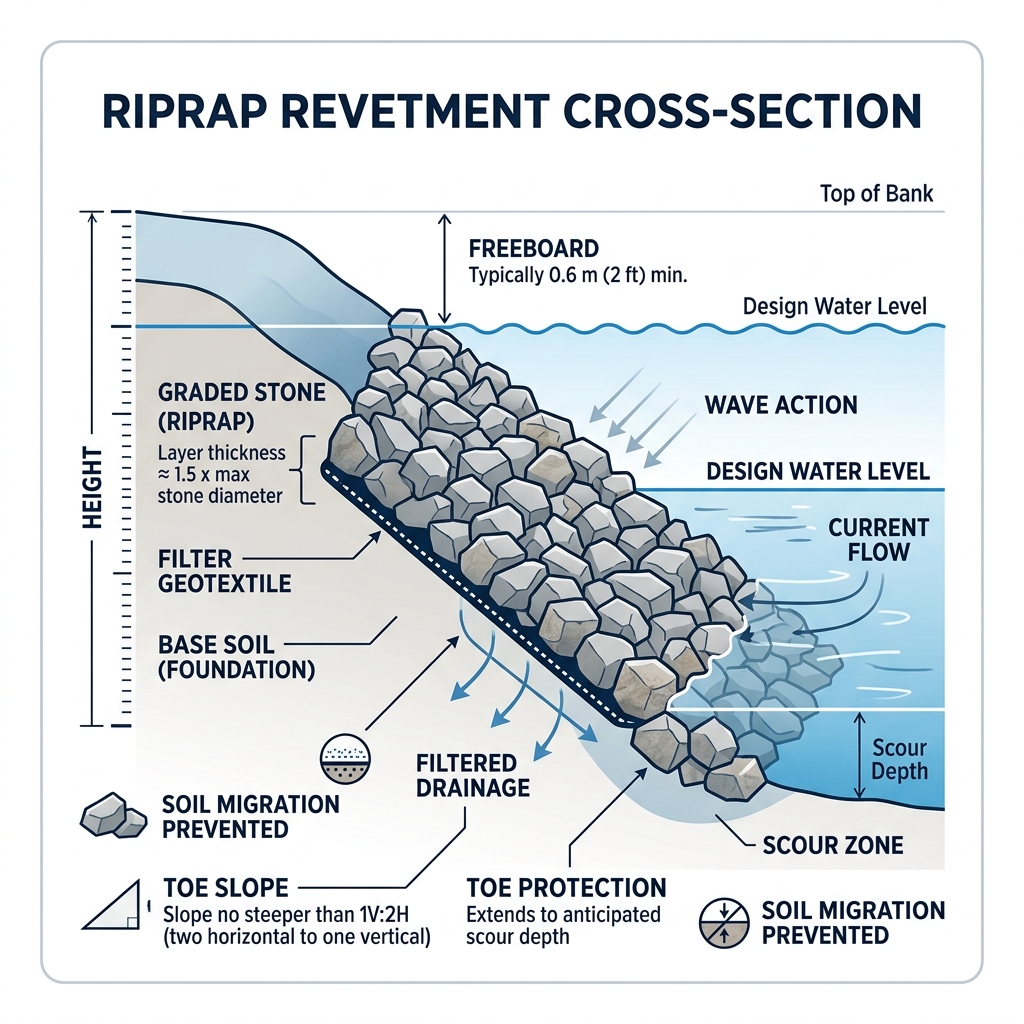
| Layer thickness | Minimum 1.5x the maximum stone diameter | ||
| Bank slope | No steeper than 1V:2H (two horizontal to one vertical) | ||
- Flow Velocity: How fast is the water moving? (Measured in feet per second, or fps).
- Shear Stress: The “drag” force the water exerts on the bank.
- Specific Gravity: We typically look for stone with a specific gravity of at least 2.5 to 2.65. This ensures the rock is heavy enough to stay submerged and stationary.
- Angular Rock: Round river rocks are pretty, but they roll. For stable riprap design, we use angular, “blocky” rock that interlocks like a puzzle.
Determining D50 and Stone Sizing
The most critical number in any riprap design is the D50. This represents the median stone diameter—meaning 50% of the stones in the mix are smaller than this size, and 50% are larger.
- Low Velocity (0-7 fps): A 10-inch D50 (about 50 lbs) is often sufficient.
- High Velocity (13-15 fps): You might need stones with a D50 of 34 inches—which can weigh up to a ton!
If you use stones that are too small, the water will simply wash them away, a process known as “particle erosion.” If you use stones that are unnecessarily large, you’re overpaying for material and transport. Finding that “Goldilocks” size is vital for shoreline stabilization.
Gradation and Layer Thickness
A pile of identical rocks isn’t actually very stable. Good riprap design requires a well-graded mixture. This means we use a variety of stone sizes so that the smaller rocks can fill the voids between the larger ones. This creates a dense, interlocking mass that prevents water from flowing underneath and pulling soil out through the cracks.
As for how deep to stack them, the industry standard for layer thickness is:
Not less than 1.5 times the D50 (median diameter).
Not less than the D100 (the maximum stone diameter).
A minimum of 12 to 15 inches for most lakefront applications.
Engineering Stable Revetments: Slope, Toe, and Filters
Designing the rock is only half the battle. We also have to design the bank it sits on. If the foundation is weak, the most expensive stone in the world won’t save your shoreline.
Protecting the Toe from Scour
If you ask any marine engineer about the “Achilles’ heel” of a shoreline, they will point to the toe. The toe is the point where the riprap meets the lake or river bed.
Toe scour is the most common cause of riprap failure. As waves hit the wall, they deflect downward, digging a hole at the base. Once that hole is deep enough, the bottom stones fall in, and the rest of the wall follows in a “translational slide.”
To prevent this, we use two main methods:
- Toe Trenches: We dig a trench at the base of the slope and fill it with heavy “toe stones” to anchor the revetment.
- Launching Aprons: We place an extra thick pile of stone at the bottom. If scour occurs, these stones “launch” or fall into the hole automatically, self-healing the gap.
For detailed technical specs on toe depth, the Design of Riprap Revetment HEC 11 is the gold standard for federal engineering.
Filter Layers and Geotextiles
You might think putting rocks directly on dirt is fine, but it’s a recipe for disaster. This leads to piping—where water gets behind the rocks and sucks the soil out through the gaps. Eventually, the ground becomes hollow, and the rocks sink.
Granular Filters: Layers of sand and gravel.
Geotextiles: Heavy-duty, non-woven “filter fabric.”
In our experience on lakes like Keowee and Lanier, a high-quality geotextile is usually the best bet. It allows water to drain out of the bank (preventing pressure buildup) while keeping the soil exactly where it belongs. This is a key reason why erosion control matters for your property value.
Step-by-Step Riprap Design and Construction
Site Assessment: We measure the bank slope (aiming for that 1V:2H ratio), water depth, and wave energy.
Subgrade Preparation: We clear the bank of brush, large roots, and debris. The surface needs to be smooth so the filter fabric doesn’t tear.
Keyway Excavation: We dig the “key”—the trench at the bottom that locks the whole system in place.
Filter Installation: We lay the geotextile fabric, ensuring at least a 12-inch overlap at the seams.
Stone Placement: We place the stones carefully using heavy machinery. Pro tip: Never “end-dump” rocks from a truck down a bank. This causes “segregation,” where the big rocks roll to the bottom and the small ones stay at the top. We place them by the bucket-load to keep the mix even.
Environmental Mitigation and Fish Habitat
We love Lake Keowee, and we want to keep it healthy. Traditional riprap design can sometimes be “sterile” for fish. To fix this, we can incorporate “mitigation measures”:
- Planting Benches: Small flat areas within the riprap where native aquatic plants can grow.
- Scalloped Shorelines: Instead of a straight wall, we create curves that provide “nooks” for small fish to hide.
- Woody Debris: Strategically placing logs or “large woody debris” (LWD) to mimic natural habitats.
In many regions, regulatory bodies follow a “No Net Loss” policy for fish habitat, so these features aren’t just nice—they’re often required.
Regulatory Approvals and Construction Windows
You can’t just start dumping rocks into Lake Keowee without a permit. Most shoreline work requires approval from Duke Energy and often state-level environmental agencies.
There are also “fisheries windows”—specific times of the year (usually during spawning season) when you aren’t allowed to do “instream work.” For example, work on the Savannah River or Lake Lanier may be restricted during certain spring months.
Maintenance, Failure Prevention, and Regional Standards
Riprap is “low maintenance,” not “no maintenance.” To maintain a healthy shoreline, you need to keep an eye on it.
Common Failure Modes and Prevention
If you notice your riprap is failing, it’s usually due to one of these four issues:
Particle Erosion: The stones are moving because they were sized too small for the waves.
Toe Loss: The bottom has washed out, and the wall is slumping.
Piping: Soil is washing out from behind the rocks because the filter layer failed or was never installed.
Translational Slide: The entire mass of rock is sliding down the bank because the slope was too steep (steeper than 1V:2H).
Inspection and Long-Term Maintenance
We recommend an annual “walk-the-line” inspection. Look for:
- Settlement: Areas where the rocks have sunk.
- Vegetation: A little grass is fine, but large trees growing through riprap can actually pry the stones apart with their roots.
- Debris: Large logs hitting your riprap during a storm can displace stones.
For those who want to get technical, the Riprap Design Criteria and Quality Control guide provides a “pebble count” method to verify if your stone gradation is still within spec after a few years.
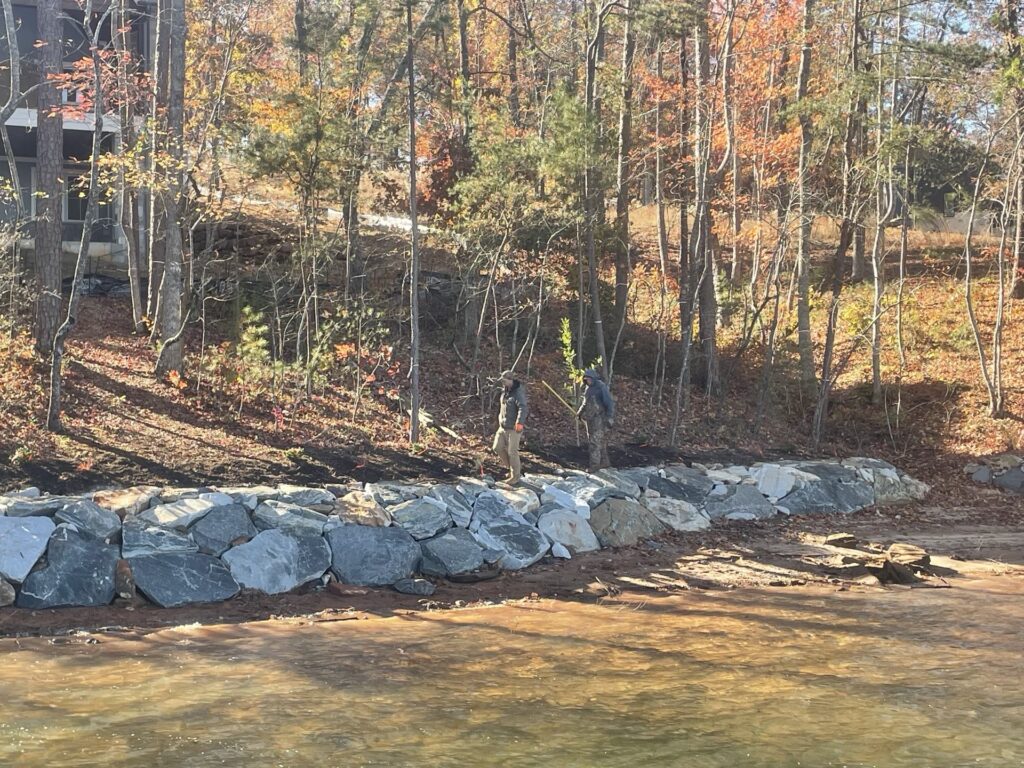
Frequently Asked Questions about Riprap Design
When should riprap be used instead of vegetation?
While we love natural shorelines, vegetation alone often fails on slopes steeper than 3H:1V or in areas with high boat wake energy. Riprap is necessary for “high-stress” areas like culvert outlets, bridge abutments, and points on the lake that catch heavy wind and waves.
What is the difference between graded and uniform riprap?
Graded riprap is a mix of sizes. It’s flexible, self-healing, and better at protecting the soil. Uniform riprap consists of stones that are all roughly the same size. It looks “cleaner” but is more rigid and prone to failure if even one or two stones move. We almost always recommend graded riprap for lakefronts.
Conclusion